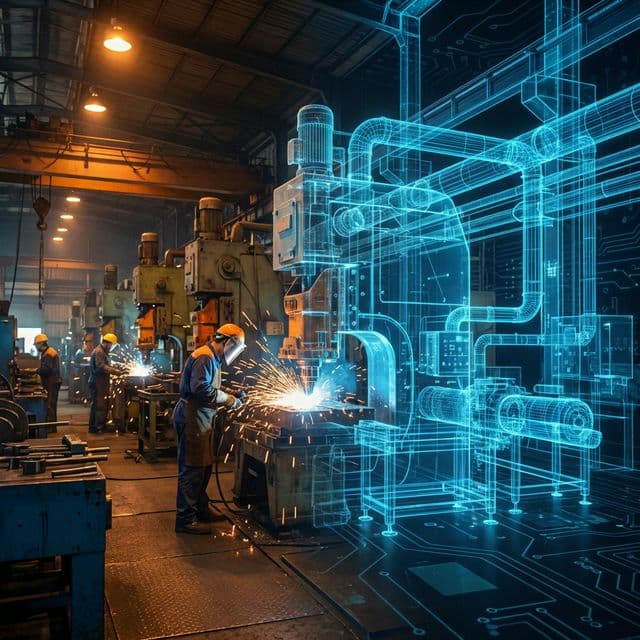
A Technology That Went From Buzzword to Backbone
I've been skeptical about digital twins for years. The concept sounded great — a virtual replica of a physical system that updates in real time — but the implementations I saw were glorified dashboards with 3D models bolted on.
2026 changed my mind.
The combination of advanced AI, cheap sensor networks, and mature cloud infrastructure has transformed digital twins from expensive novelties into operational necessities. And the applications are far broader than I expected.
What Are Digital Twins, Really?
A digital twin is a dynamic virtual model of a physical object, process, or system. Unlike a static simulation, it:
- Updates in real time from live sensor data (IoT, cameras, environmental monitors)
- Predicts future states using ML models trained on historical patterns
- Simulates scenarios without disrupting the physical system
- Learns continuously from the gap between predicted and actual outcomes
The key insight: a digital twin isn't a snapshot. It's a living model that gets smarter over time.
Where I'm Seeing Real Impact
Manufacturing: BMW's iFactory
BMW's iFactory project is the poster child for digital twins done right. They've replicated their entire production pipeline — every robot, conveyor, and quality checkpoint — in a digital twin that runs in parallel with the physical factory.
What this enables:
- Disruption simulation — test what happens when a supplier is 2 days late, a machine breaks down, or demand spikes 40%
- Process optimization — test thousands of assembly sequence variations without stopping production
- Predictive maintenance — identify machine failures hours before they happen
Xiaomi's Hyper Intelligent Manufacturing Platform takes this further with autonomous process operation — the digital twin doesn't just simulate; it makes decisions and executes them.
Healthcare: Personalized Cancer Treatment
This is the application that genuinely amazed me. Researchers are creating patient-specific digital twins for cancer treatment:
- A virtual model of the patient's tumor, built from imaging data and genetic profiles
- Real-time simulation of how different treatments (chemo, radiation, immunotherapy) would affect tumor growth
- Optimization of treatment protocols before administering them to the actual patient
The implications are profound: fewer trial-and-error treatment cycles, reduced side effects, and dramatically faster time-to-effective-treatment.
Medtronic is using similar approaches for real-time surgical assistance — the digital twin of a patient's anatomy guides surgeons during procedures.
Energy: Grid Stability and Renewables
Digital twins of power grids are helping utilities balance the inherent unpredictability of renewable energy:
- Wind farm optimization — adjusting turbine angles based on real-time weather models
- Grid stability — simulating demand fluctuations and preemptively adjusting supply
- Smart buildings — monitoring energy consumption in real-time and optimizing for zero-energy performance
Urban Planning: City-Scale Twins
Entire cities are being modeled as digital twins for scenario planning. When an unexpected event occurs (flooding, infrastructure failure, population surge), city planners can simulate response strategies before implementing them.
The Technology Stack
What's enabling this wave of adoption:
| Layer | Technology |
|---|---|
| Data | IoT sensors, LIDAR, satellite imagery |
| Processing | Edge computing + cloud GPU clusters |
| Modeling | Physics-based simulation + ML hybrids |
| Interface | Spatial computing, AR/VR, natural language |
| AI | LLMs for querying, ML for prediction, GenAI for scenario generation |
The integration of spatial computing is particularly interesting — engineers can literally walk through a virtualized factory, inspect equipment, and test modifications in an immersive environment.
What This Means for Developers
If you're a developer in 2026, digital twins represent an emerging career opportunity:
- Data engineering — building pipelines from IoT sensors to twin models
- ML/AI — training predictive models on operational data
- 3D/spatial computing — creating immersive twin interfaces
- Full-stack — building the platforms that orchestrate all of the above
The tooling is maturing rapidly. NVIDIA's Omniverse, AWS IoT TwinMaker, and Microsoft's Azure Digital Twins are making it increasingly accessible to build without starting from scratch.
My Reflection
What struck me most about researching this topic is how quietly digital twins have matured. There's no hype cycle, no viral demos, no Twitter debates about whether they're "real" technology. They're just… being used. By factories, hospitals, power grids, and cities.
That's the hallmark of technology that actually works: it becomes invisible. It's infrastructure, not spectacle.
As someone who tends to follow the flashy AI developments (new models, new benchmarks, new controversies), this was a healthy reminder that some of the most impactful AI applications don't make headlines. They prevent factory shutdowns, optimize cancer treatments, and keep the lights on.
Sometimes the most important technology is the one you never notice.
Are you working with digital twins in your organization? I'd love to hear about real-world implementations — the successes and the challenges.